

No, if your customer is acting in the course of a profession or business (such as a B.V., V.O.F., or a sole proprietor/self-employed individual making a business purchase), a 14-day notice is not required by law. A business debtor is automatically in default immediately after the due date. A sole proprietor making a personal purchase is, however, legally considered a consumer.
- Why B2B creditors often unnecessarily follow consumer protection rules
- Overview: The 5 Key Differences Between Business Debt Collection (B2B) and Consumer Debt Collection (B2C)
- Difference 1 & 2: Automatic default on day 31 and your own collection rates in your terms and conditions
- Differences 3, 4, and 5: Statutes of limitations and enforcement measures (seizure and bankruptcy)
Why B2B creditors often unnecessarily follow consumer protection rules
In our day-to-day work with small and medium-sized businesses and large organizations, we see a striking pattern: many business owners treat a delinquent B.V., V.O.F., or sole proprietorship exactly the same as a private consumer. They first send a non-binding reminder, then grant another 14 days of interest-free grace period via a WIK letter, and subsequently charge only €40 in collection fees.
From a legal standpoint, this means you’re missing out on both time and significant returns when dealing with business debtors. Dutch law provides consumers with extensive protection (mandatory law), but in commercial transactions between businesses (Article 6:119a of the Dutch Civil Code and Article 6:96(4) of the Dutch Civil Code), it assumes freedom of contract and professional diligence.
Good to know: At Credifin, we focus on commercial claims and B2B organizations. Do you have a purely private claim without a Chamber of Commerce registration? In that case , we will only handle it if the principal amount is at least €1,000.
Overview: The 5 Key Differences Between Business Debt Collection (B2B) and Consumer Debt Collection (B2C)
The table below shows at a glance which legal rules will apply in 2026 when you invoice a business customer (registered with the Chamber of Commerce) versus a private consumer:
| Subject | Business Debt Collection (B2B) | Consumer debt collection (B2C) |
|---|---|---|
| 1. Date of Absence | Automatically on day 31 | After the mandatory 14-day notice (WIK) |
| 2. Collection fees | Custom fee permitted (min. €40) | Max. statutory sliding scale (min. €40) |
| 3. Statutory interest rate (2026) | 10.40% commercial interest rate per year | 4.00% consumer interest rate per year |
| 4. Cumulation Rule | Not applicable (always at least €40) | Required for installments under €266.67 |
| 5. Statute of limitations | 5 years (plus bankruptcy petition) | 2 years (consumer purchase) or 5 years |
In the sections below, we explain, for each component, how you, as a business creditor, can immediately benefit from this in practice.
Overview: The three biggest financial and legal differences between business debt collection (B2B) and consumer debt collection (B2C) in 2026.Difference 1 & 2: Automatic default on day 31 and your own collection rates in your terms and conditions
The biggest time difference in business debt collection lies in when default occurs. If you agree on a 30-day payment term with a business customer and the invoice has not been credited by day 30? Then, on day 31, your business debtor is automatically in default (Article 6:83(a) of the Dutch Civil Code in conjunction with Article 6:96(4) of the Dutch Civil Code).
That means two things:
- When dealing with a business customer, you are not required to first send a 14-day notice before you can charge collection fees and 10.40% commercial interest. Starting on the 31st day, the statutory minimum fee of €40 is immediately due and payable.
- Have you specified in your general terms and conditions that, in the event of late payment, a business debtor is liable for 15% in extrajudicial collection costs on the full principal amount (with a minimum of, for example, €150 or €250) and 1% to 1.5% contractual interest per month? In that case, this contractual agreement takes precedence over the statutory WIK scale in B2B transactions, provided that your terms and conditions have been correctly declared applicable.
Chart: Business Debt Collection (B2B) vs. Consumer Debt Collection (B2C) in 2026
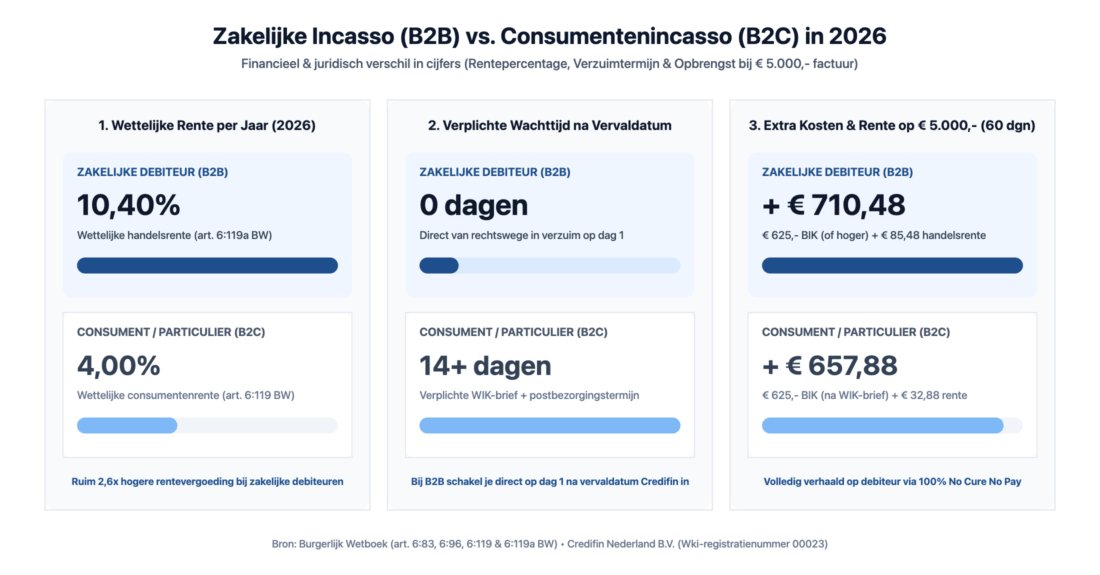
Overview of the differences in the statutory interest rate (10.40% vs. 4.00%), the grace period, and collection fees in 2026.
Differences 3, 4, and 5: Statutes of limitations and enforcement measures (seizure and bankruptcy)
In the follow-up process as well, you have considerably more legal leverage with a business debtor than with a private individual:
- No 2-year statute of limitations as in consumer sales: If you, as an online store or supplier, sell a product to a consumer, your claim expires after just 2 years (Article 7:28 of the Dutch Civil Code). If you supply that same product to a business (B2B), the standard 5-year statute of limitations applies.
- Preventive Attachment of Business Accounts or Inventory: Is a business debtor threatening to divert assets before a judgment is issued? In that case, we can obtain a preventive attachment order from the judge in preliminary relief proceedings against business accounts, accounts receivable, or business inventory.
- Filing for Bankruptcy as a Business Leverage Tool: Does a B.V. systematically fail to pay its debts, and is there at least one other creditor (the required supporting claim)? In that case, filing for bankruptcy is often the quickest way to compel a director to make full payment before the court hearing date.
Sample Calculation in Euros: B2B Receivables vs. B2C Receivables in 2026
To illustrate just how much of a financial and legal difference it makes whether your customer is a business (B2B) or a consumer (B2C), we’ll calculate the exact same outstanding invoice of €5,000 (which is 60 days past due) under the 2026 rules:
| Part of the claim | Business customer (B2B) | Residential customer / Consumer (B2C) & How this affects you as a creditor |
|---|---|---|
| Original principal amount | €5,000.00 | €5,000.00 Equal |
| Mandatory waiting period after the due date | 0 days (deemed in default by operation of law on the first day after the due date) | At least 14 days plus postal delivery time after receipt of a formal WIK letter For B2B transactions, you can arrange for collection at least 2 to 3 weeks earlier |
| Statutory collection fees (BIK scale) | €625.00 (immediately due without a 14-day notice; or higher in accordance with your B2B terms and conditions) | €625.00 (payable only if this exact amount was specified in advance in the WIK letter) With B2B, you run no risk whatsoever of formal errors in the 14-day notice |
| Statutory interest over 60 days (2026) | €85.48 (based on a 10.40% statutory commercial interest rate) | €32.88 (based on 4.00% statutory consumer interest rate) More than 2.5 times as much interest charged to business debtors |
| Total amount owed by the debtor | €5,710.48 | €5,657.88 Faster collection + higher interest + immediate 100% No Cure No Pay collection |
A Smart Tip for Entrepreneurs: What Should You Include in Your Business Terms and Conditions?
Because the legislature assumes that businesses have freedom of contract among themselves, you can further strengthen your position in business-to-business (B2B) debt collection by including certain provisions in your own general terms and conditions. Always include the following three provisions in your quote and general terms and conditions:
- A strict, non-negotiable payment deadline: Explicitly state that payment must be made no later than 14 or 30 days after the invoice date and that, if this date is exceeded, the business client will immediately be in default by operation of law, without the need for a further notice of default.
- Contractual B2B collection fees and interest: For consumers, you may never deviate from the statutory BIK scale (mandatory law), but for business customers, the BIK scale is a matter of regulatory law. For example, in B2B terms and conditions, you may stipulate that, in the event of default, 15% in extrajudicial collection fees on the full principal amount is always due (with a minimum of, for example, €150) plus contractual late-payment interest of 1% per month.
- Short Complaint Period: Specify that any objections to the invoice or the goods/services provided must be reported in writing, with a detailed explanation, no later than 8 or 14 days after the invoice date. This prevents a business debtor from waiting three months—until you engage Credifin —to raise a fabricated complaint about quality for the first time in order to delay payment.
Business invoice unpaid? Don't miss out on commercial interest and fees
Has your business customer’s payment deadline passed? Submit your claim online within 5 minutes on a 100% “No Cure, No Pay” basis. We’ll collect both the principal amount and the 10.40% commercial interest, as well as collection fees, directly from your debtor.
Frequently Asked Questions About Business Debt Collection (B2B)
Yes, in B2B relationships, the WIK scale is the governing law (Article 6:96(4) of the Dutch Civil Code). This means that you may legally agree in your contract or general terms and conditions to a higher percentage (for example, 15% of the total principal amount) and a higher minimum amount (for example, €150 instead of €40).
We handle business debt collection cases during the amicable phase on a 100% “No Cure, No Pay” basis. We recover the collection costs and the statutory commercial interest rate (10.40%) directly from your business debtor. Learn more on our debt collection fees page.
Related articles from our knowledge base

Integrating Direct Debit with Your Accounting Software (Exact, AFAS, Twinfield, and Odoo): How Automatic Bulk Direct Debit Works

The Wki Cumulative Payment Scheme in 2026: Calculating Collection Fees for Monthly Payments (Rent, Premiums, and Subscriptions)