

Setting up an API integration, SFTP connection, or a fixed CSV/Excel import profile with Credifin is completely free of charge. You pay no setup fees, no license fees, and no monthly subscription fees. We also operate on a “No Cure, No Pay” basis for linked bulk direct debits.
When should you switch from manual submission to an API or batch integration?
As soon as a company’s financial records grow beyond five to ten unpaid accounts per month, manually retyping name, address, and contact information, invoice numbers, and attachments becomes an error-prone and time-consuming task. In practice, we see three bottlenecks arise in manual accounts receivable management at large organizations and growing small and medium-sized businesses:
- Duplicate Record-Keeping for Partial Payments: A debtor transfers €250 to your business IBAN while the case is already being handled by the collection agency. If that transaction isn’t synchronized immediately, the collection agency will send a demand letter with an outdated balance. Under the Debt Collection Services Quality Act (Wki), this constitutes an immediate compliance risk.
- Delay Between Due Date and Transfer: The longer an overdue invoice remains in the credit controller’s work queue, the lower the ultimate chance of collection. With an automated workflow, a file is automatically forwarded on day 45 or day 60 after the invoice date.
- Verification of Required Documentation: To file a legally valid claim, you always need the original invoice (PDF), the due date, and—for consumer claims—proof of the 14-day notice (WIK letter). A data link validates in advance whether these fields are present.
The 3 Ways to Integrate Your Accounting Software or ERP with Credifin
Not every organization needs its own IT department to automate collections. Depending on your monthly volume and your ERP system, we offer three options:
| Pairing Method | Monthly volume | Accounting Software / ERP & Processing Time |
|---|---|---|
| 1. Online Web Portal | 1 to 15 files | Each package (upload PDF) Instant (5 minutes) |
| 2. Batch Import (CSV) | 15 to 250 records | Exact, Twinfield, SnelStart, Visma : Within 1 business day |
| 3. Direct REST API | 50 to 10,000+ records | Exact Online, AFAS, Odoo, SAP Free (1–3 days) |
Do you work with industry-specific software packages—for example, in the real estate sector (Realworks, Tobias, Yardi), at insurance companies and authorized agents (ANVA, CCS), healthcare institutions, or in childcare (KidsKonnect, Konnect)? If so, our developers will set up a dedicated integration interface that matches your export format—free of charge.
Real-world figures for 2026: The sooner an overdue invoice is followed up on from the accounting software, the higher the success rate in the amicable collection process (up to 94%).Which 6 data fields are required for a Wki-compliant collection file?
Since the implementation of the Wki (Credifin is registered with the Justis Agency under number 00023 ), every claim must be fully traceable and transparent from the very first minute. When you submit files via our API or a CSV batch, we automatically check these six key fields:
- Relationship Type (B2B or B2C): This directly determines whether our system applies the statutory commercial interest rate of 10.40% (and any contractual terms) or the consumer interest rate of 4.00% and the mandatory WIK scale. For purely private claims without a Chamber of Commerce registration, we also apply our fixed minimum threshold of €1,000 in principal.
- Chamber of Commerce number or date of birth & address information: For business debtors, we immediately enrich the Chamber of Commerce number with up-to-date commercial registry data to immediately identify changes in legal form or companies that have been struck from the registry.
- Invoice number, invoice date, and original due date: Required to calculate the exact number of days on which interest accrues from the date the payment became overdue.
- Original principal amount and current outstanding balance: Have any partial payments or credit memos been posted? If so, we list them separately so the debtor can see exactly how the remaining balance was calculated.
- Date of the last reminder / 14-day notice (for B2C): For consumer claims, our software verifies whether the statutory 14-day payment period (plus postal delivery time) has actually expired.
- Your organization’s VAT status: Are you exempt from VAT (such as in healthcare, insurance, education, or non-opted-in rentals)? If so, our software automatically increases the collection fees by the statutory 21% VAT surcharge (minimum €48.40 instead of €40.00).
Overview by Accounting Software: How Do You Integrate with Credifin?
Whether you’re managing a single small business’s books or, as a CFO, overseeing multiple operating companies, every modern accounting software package supports a direct data connection or bulk data transfer to our online collection portal. The table below shows, for each software package, how the data exchange works and which fields are automatically included:
| Accounting Software / ERP | Integration Method | Data Automatically Imported & Post-Payment Feedback |
|---|---|---|
| Exact Online & Exact Globe | REST API / Webhook or direct XML/CSV export of aging analysis | Accounts receivable card, Chamber of Commerce number, invoice number, due date, outstanding balance, and PDF invoice Real-time status update in the portal + breakdown of principal and interest collected |
| AFAS Software (Profit) | AFAS GetConnector & UpdateConnector (API) | Sales Relationship, outstanding items, payment reminder history, and file attachments Automatic reconciliation specification and status updates per receivable |
| Twinfield / Yuki / SnelStart | API integration or automated batch upload | Customer details, invoice amount, VAT breakdown, and payment status Clear payment statement for direct processing in the general ledger |
| Moneybird / e-Bookkeeping / Custom ERP | Webhooks / REST API or 1-click online submission | Full invoice PDF, customer details, and due date Immediate notification for partial payments, payment plans, or full collections |
Case Study: What Are the Benefits of Automated Follow-Up for an SME?
Suppose a wholesaler or business service provider sends out 250 invoices each month with a 30-day payment term. On average, 15 to 20 invoices remain unpaid after 45 days. With manual accounts receivable management, finding the right contact person, verifying partial payments, and drafting a final reminder or WIK letter can easily take 20 minutes per file—more than 6 hours of administrative work per month. Furthermore, delays mean that invoices are not transferred until after 90 days, by which time the likelihood of successful out-of-court collection has already dropped significantly.
With a fixed workflow (where invoices automatically receive a reminder on day 31, a formal demand letter or WIK letter (€20, excluding VAT) on day 45, and are immediately forwarded to Credifin on day 60 based on a 100% No Cure No Pay), you can shorten the average payment term (DSO) by 18 to 24 days. Not only do you save valuable hours on financial administration, but you also immediately have more working capital at your disposal without unnecessarily straining the customer relationship.
Chart: Success Rate of Amicable Debt Collection & API Accounting Integration (2026)
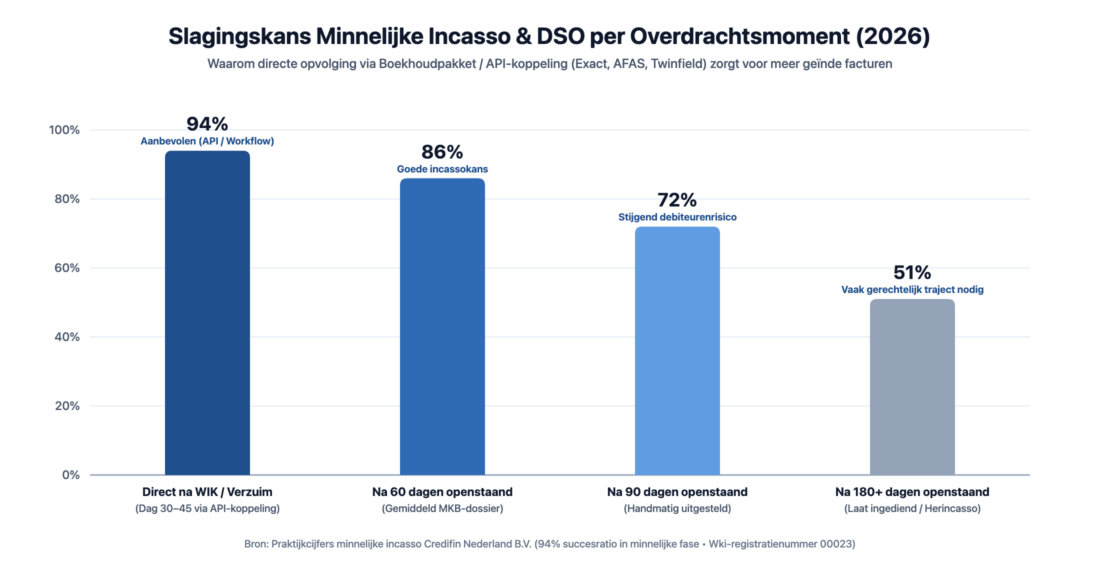
2026 Performance Figures: Timely data transfer from your accounting software (Exact, AFAS, Twinfield) increases the likelihood of an amicable resolution to 94%.
How does automatic posting and reconciliation work in your general ledger?
A good debt collection integration works both ways. Once a case is being handled by Credifin, as a CFO or credit controller, you don’t want to have to manually request status reports every week. Our integration with your accounting software and online portal automatically handles three things:
- Real-time transaction updates for direct payments: Does your customer still pay directly into your bank account after our first demand for payment? As soon as the bank transaction is reconciled in Exact, AFAS, or Twinfield, our system is immediately notified. The collection process stops for that amount, and we will only collect the outstanding collection fees and interest from the debtor.
- Legal Order of Allocation (Article 6:44 of the Dutch Civil Code): Does a debtor make payments to Credifin in installments? According to Article 6:44 of the Dutch Civil Code, a payment is first applied to the costs, then to the accrued interest, and only lastly to the principal. Our reports break down these components down to the cent for your general ledger.
- File status for the accountant and allowance for doubtful accounts receivable: Should a receivable be written off as uncollectible before the year-end closing (so you can claim a refund of the VAT paid to the tax authorities)? If so, you’ll automatically receive a year-end closing report with the formal documentation for your accountant.
Set up a free API integration or batch import?
Would you like to see how much time you can save by directly integrating Exact Online, AFAS, Twinfield, Odoo, or your industry-specific software with our direct debit system? Our specialists will set up the integration for you completely free of charge on a 100% “No Cure, No Pay” basis.
Frequently Asked Questions About Integrating Debt Collection with Your Accounting Software
Yes. Through our two-way synchronization (REST API and webhooks), partial payments, credit memos, and direct payments to your own bank account are automatically processed in the collection file. This prevents a customer from receiving an unjustified reminder for an invoice that has just been paid.
Yes, our debt collection software automatically validates every new claim against the rules of the Debt Collection Services Quality Act (Wki). For recurring monthly installments from the same consumer, the system automatically calculates the mandatory cumulative penalty scale (€40 plus €20 per subsequent installment) and ensures that the mandatory early warning is issued in a timely manner.
Related articles from our knowledge base

Business Debt Collection (B2B) vs. Consumer Debt Collection: The 5 Legal Differences in 2026

The Wki Cumulative Payment Scheme in 2026: Calculating Collection Fees for Monthly Payments (Rent, Premiums, and Subscriptions)