

No. The Wki accumulation rule and the reduced follow-up fee of €20 apply only when the debtor is a natural person (consumer) who is not acting in the course of a profession or business. For business customers (B2B), you are immediately entitled to a minimum of €40 in collection fees per overdue invoice (Art. 6:96(4) of the Dutch Civil Code) or the higher percentage specified in your general terms and conditions.
- What is the Wki accumulation scheme, and who is eligible for it?
- How do you calculate the cumulative collection costs? (Formula + Calculation Table)
- What happens if you first issue a joint demand for two months in a single WIK letter?
- Impact by Industry: Real Estate, Insurance, Healthcare, Associations & Child Care
What is the Wki accumulation scheme, and who is eligible for it?
Anyone who works with recurring payment agreements—such as monthly rent, insurance premiums, gym membership fees, energy advance payments, or parental contributions—regularly deals with debtors who fail to pay for two, three, or four consecutive months. Before the entry into force of the Act on the Quality of Debt Collection Services (Wki) and the amendment to the Decree on Compensation for Extrajudicial Collection Costs, a separate minimum collection fee of €40 was charged for each overdue monthly installment following a 14-day reminder letter.
The legislature considered this accumulation of relatively small monthly amounts to be unreasonably burdensome for consumers. Therefore, starting in 2026, a mandatory accumulation rule will apply as soon as these three conditions are met:
- The debtor is a natural person (consumer / B2C) who is not acting in the course of a profession or business;
- This refers to multiple monthly installments under the same continuing contract that have become due within a 6-month period;
- The individual monthly installments are less than €266.67 per month (the threshold amount at which 15% equals exactly the statutory minimum of €40).
Note the difference from B2B: Are you renting commercial property to a limited liability company (B.V.) or collecting business subscription fees from a business customer? In that case, these consumer protections do not apply. You can read more about this in our overview of business debt collection (B2B) vs. consumer debt collection.
How do you calculate the cumulative collection costs? (Formula + Calculation Table)
As soon as a consumer leaves multiple monthly installments of less than €266.67 unpaid within a six-month period—for which you have previously sent a 14-day notice (WIK letter) —the law requires that you calculate the extrajudicial collection costs as follows:
- For the first unpaid monthly installment, charge the standard statutory minimum of €40.00 (or €48.40 including a 21% VAT surcharge if you are not subject to VAT);
- For each subsequent unpaid monthly installment within the same 6-month period , the minimum amount is €20.00 per monthly installment (or 15% of that individual monthly installment if that amount exceeds €20);
- The general rule (comparison test): You always compare this total (€40 + €20 per additional month) with the standard WIK percentage (15% on the first €2,500), calculated on the total of all outstanding monthly installments. You may charge the higher of the two amounts.
| Status (3 installments) | Total principal amount | Collection fees for 2026 & incl. 21% VAT surcharge |
|---|---|---|
| 3 × €60.00 (membership fee) | €180.00 | €80.00 (€40 + €20 + €20) €96.80 |
| 3 × €160.00 (health care / childcare) | €480.00 | €88.00 (€40 + €24 + €24) €106.48 |
| 3 × €850.00 (monthly rent) | €2,550.00 | €380.00 (standard sliding scale) €459.80 |
How are these amounts determined? With 3 installments of €60, you could charge 3 × €40 = €120 before the Wki; under the cumulative rule, that amount is €80.00 (because €40 + €20 + €20 is higher than 15% of €180). For 3 installments of €160, 15% per month amounts to €24.00 (higher than the minimum of €20), bringing the total to €88.00. With a monthly rent of €850, each installment exceeds the threshold of €266.67, so the standard WIK scale applies. Use our free debt collection fee calculator to run the numbers for your case right away.
Chart: Comparison of statutory collection costs under the Wki accumulation rule (2026) for a 3-month payment arrears.What happens if you first issue a joint demand for two months in a single WIK letter?
In practice, many organizations wait to send a formal 14-day notice until two monthly installments are past due. This has a significant impact on the calculation:
If you have not yet sent a legally valid 14-day notice for Month 1 and you combine Month 1 and Month 2 into a single 14-day notice, then both months are considered by law to be a single aggregate principal amount. Suppose this involves 2 months of €90 each (total €180): because you’re combining them into a single notice, you may charge the minimum fee of €40.00 only once on that €180 (and not €40 + €20 = €60).
Only if you send your own 14-day notice in a timely manner for each overdue monthly payment and take decisive action if payment is not received will you be entitled to the accrual of €40 for month 1 plus €20 (or 15%) for month 2.
Chart: Wki Accumulation Plan 2026 with Monthly Installments
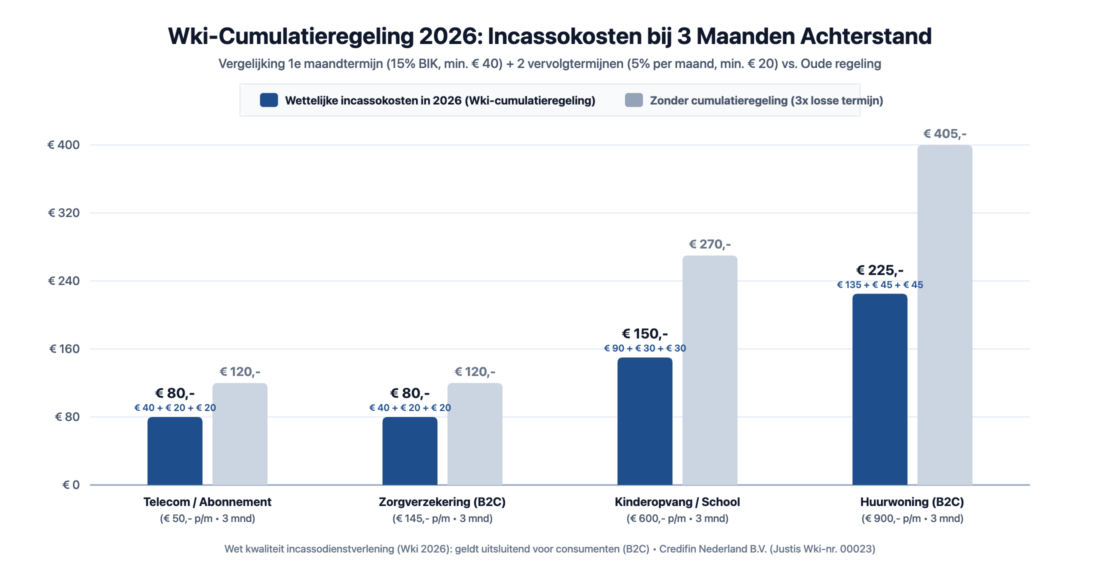
Comparison of statutory collection costs under the Wki accumulation rule in 2026 for a 3-month payment arrears.
Impact by Industry: Real Estate, Insurance, Healthcare, Associations & Child Care
Because both the Inspectorate of Justice and Security and the subdistrict courts will, as of 2026, automatically verify whether the cumulative rule and the 21% VAT surcharge have been correctly applied, the ideal structure varies by sector:
- Rent Collection & Real Estate: For single-family homes and commercial properties, the base monthly rent is almost always above €266.67 (which means a 15% rate applies per installment), but for separate utility bills, garage spaces, or storage units with rents below €266.67, the cumulative payment arrangement is mandatory. In addition, for residential leases, the statutory early warning system for rent arrears applies.
- Insurers & Authorized Agents: For monthly property damage or liability premiums ranging from €35 to €200, the cumulative limit rule applies on a daily basis, combined with the statutory suspension of coverage (Art. 7:934 of the Dutch Civil Code) and the 21% VAT surcharge due to the insurance exemption.
- Healthcare Facilities & Child Care / Education: Both periodic patient copayments in healthcare and monthly parental contributions for after-school care/child care are exempt from VAT. Our direct debit software automatically calculates the correct cumulative scale for each monthly installment, including the 21% VAT increase.
- Associations, Cooperatives & Subscriptions: For quarterly or monthly dues, we ensure that the breakdown on the demand notice clearly shows which payment period corresponds to which 14-day notice. This helps prevent a small claims judge from rejecting the collection costs in legal proceedings.
Detailed real-world examples: 2, 3, and 6 months behind
In the day-to-day operations of property managers, insurers, telecom providers, and childcare organizations, payment arrears often accumulate over several months. Even when a consumer makes a small partial payment or when multiple installments are transferred to a collection agency at the same time, the accumulation rule must be applied precisely on a monthly basis. See below how the calculation works out for different monthly amounts:
| Type of Agreement & Monthly Term | Arrears | 1st installment (15% of gross income, min. €40) & Subsequent installments (5% per month, min. €20) & Total statutory collection fees (2026) |
|---|---|---|
| Health Insurance or Subscription (€145 per month) | 3 months (€435 total) | €40.00 (regular minimum) 2 × €20.00 = €40.00 (5% is €7.25, so the reduced minimum of €20 applies) €80.00 (instead of €120.00 under the old system) |
| Private Rental Property (€900 per month) | 2 months (€1,800 total) | €135.00 (15% of €900) 1 × €45.00 (5% of €900 exceeds the minimum of €20) €180.00 (provided a WIK letter was correctly sent for both months) |
| Childcare or Private Education (€600 per month) | 3 months (€1,800 total) | €90.00 (15% of €600) 2 × €30.00 = €60.00 (5% of €600 per month) €150.00 (or 15% of the combined total if only one WIK letter was sent beforehand) |
| Business Rental / Business Lease (B2B, €1,200 per month) | 2 months (€2,400 total) | €180.00 (15% of €1,200) €180.00 (The Wki accumulation rule does not apply to B2B contracts) €360.00 + 10.40% statutory commercial interest |
Wki Quality Requirements (Justis Registration Number 00023): Why This Matters to You as a Creditor
Since the enactment of the Debt Collection Services Quality Act (Wki), small claims judges have been scrutinizing both the registration of the debt collection agency and the breakdown of the claimed collection costs more strictly than ever. If you engage a party that is not listed in the national debt collection registry maintained by Justis, or if there is a calculation error in the 14-day notice (WIK letter), the judge will automatically reject the claim for extrajudicial debt collection costs. Credifin Nederland B.V. holds the official WIK license under registration number 00023. Our systems automatically verify every consumer claim against the 6-month rule and the 5% cap, ensuring that your claim is 100% valid both in the out-of-court process and in any potential legal proceedings.
Is it 100% Wki-compliant to collect payments in monthly installments?
Are you unsure whether your 14-day notices and collection fees for monthly installments comply with the 2026 Wki accumulation rule? Submit your file right away or connect your records for free via our API. We’ll calculate each installment for you down to the cent.
Frequently Asked Questions About the Wki Cumulative Allowance Scheme
Yes. In order to charge a consumer out-of-court collection fees for a new overdue monthly installment, you must first send the consumer a free 14-day notice (WIK letter) stating the correct (cumulative) amount of collection fees.
As soon as a monthly installment is €266.67 or higher (as is often the case with monthly rent), that installment falls outside the special €20 threshold for small installments. For the total of outstanding installments within a 6-month period, you then apply the standard statutory WIK scale (15% on the first €2,500, 10% on the next €2,500, and so on).
Related articles from our knowledge base

Integrating Direct Debit with Your Accounting Software (Exact, AFAS, Twinfield, and Odoo): How Automatic Bulk Direct Debit Works

Business Debt Collection (B2B) vs. Consumer Debt Collection: The 5 Legal Differences in 2026